
• Home
  • About Us
  • Services
    • Tree & Shrub Pruning
    • Tree & Stump Removal
    • Plant Health Care
    • Arborist & Consulting
    • Tree Restoration
    • Soil Amendments & Fertilizing
  • Commercial
  • News
  • FAQs
  • Contact Us
OntreeOntree
  • Home
  • About Us
  • Services
    • Tree & Shrub Pruning
    • Tree & Stump Removal
    • Plant Health Care
    • Arborist & Consulting
    • Tree Restoration
    • Soil Amendments & Fertilizing
  • Commercial
  • News
  • FAQs
  • Contact Us

Info Bulletin: Cytospora Canker

Info Bulletin: Cytospora Canker

Info Bulletin: Cytospora Canker

September 4, 2012 Bulletins & Alerts 1 Comment

Cytospora Canker

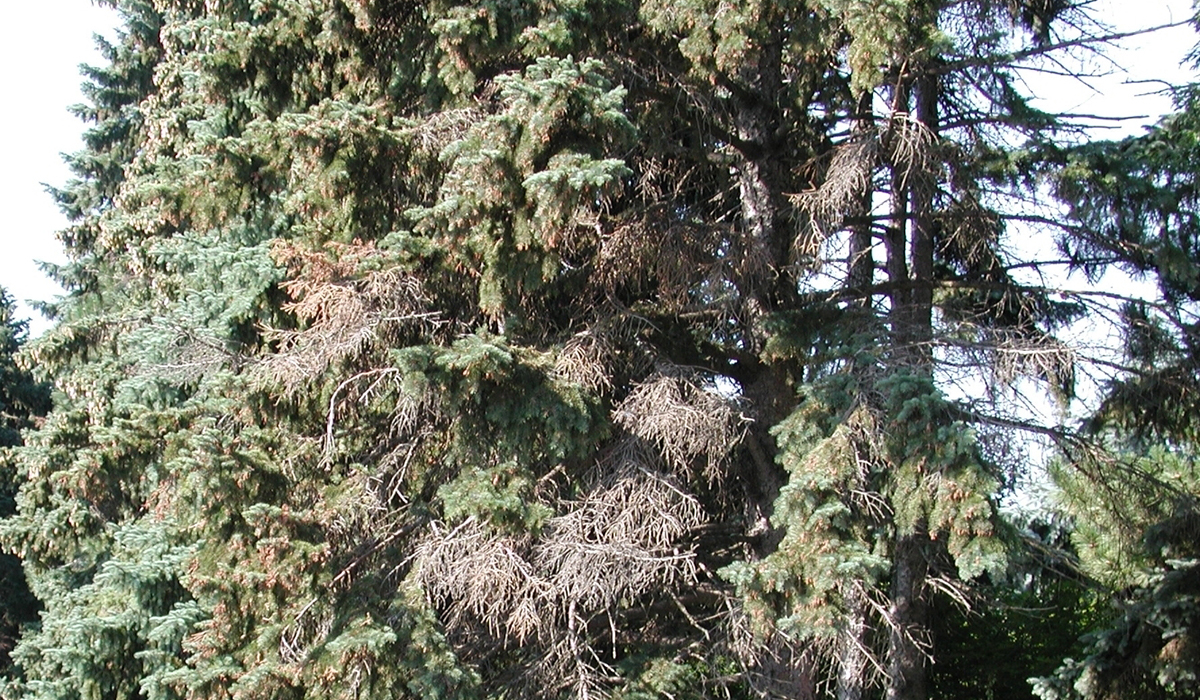
A disease causing branch dieback in many species of conifers, particularly in Colorado blue spruce.

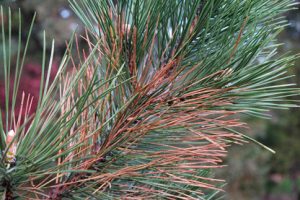
This disease also attacks other two and three needled pines such as mugo, Scots, and red pines.

Symptoms

  • Dead branches
  • Dying branches (needles of infected branches change colour)
  • Pitch oozing from infected branches and stems

Causes

Cytospora attacks weakened trees that are growing under stressful conditions. Stress can be caused by many factors (root damage, poor soil conditions, heat, salt), but especially by drought.

Treatment

There is no direct cure for cytospora. It is important to remember that cytospora attacks weakened trees, so methods of treatment should focus on improving the tree’s health. Making the tree healthier may enable it to prevent further advancement of the disease. Cultural practices such as pruning dead and dying branches, fertilizing, mulching and watering will help to improve the tree’s health. Note that a watering program should extend into the fall season because the roots of most conifers grow more at that time than at any other.
Save

Save

Save

Save

Tags: blue sprucebranch diebackconiferscytospora cankerdead branchesdroughtMugoRed Pinesroot damageScots
1 Comment
Share
4

You also might be interested in

Watering trees

Watering trees

Sep 22, 2012

Key points for watering trees Watering is perhaps the best[...]

Info Bulletin: Diplodia Tip Blight

Info Bulletin: Diplodia Tip Blight

Jun 21, 2012

Diplodia is one of the most common and serious diseases of Austrian pines. It is caused by a fungus which becomes a destructive pathogen when its host is weakened by external factors. This disease also attacks other two and three needled pines such as mugo, Scots, and red pines.

1 Comment

Leave your reply.
  • Anthony Chan

    August 22, 2016 at 2:48 PM

    I have two blue spruces. Almost all of the needles from the branches near the bottom of the trees fell off. At certain spots on the truck there are some white sap coming out. How to treat this problem and prevent it from getting worse? Would the dried branches coming back ?
    Thanks.

    Anthony

Leave a Reply

Your email is safe with us.

Most Commented Posts

  • Birch leafminer treatment now available in Ontario By Ontree on February 15, 2013 4
  • Magnolia Scale Neolecanium Cornuparvum By Ontree on August 7, 2015 3
  • Pruning young trees and structural pruning By Ontree on September 8, 2014 2

Recent Comments

  • John Shribbs on Pruning young trees and structural pruning
  • Yuma on Pruning young trees and structural pruning
  • Madeline Walker on Using pesticides on trees
  • Ontree on Birch leafminer treatment now available in Ontario
  • Teressa on Birch leafminer treatment now available in Ontario

Search

Ontree

To preserve the urban forest by adding value, maintaining high standards, and developing relationships.

Contact

Ontree
22 Passmore Ave,
Scarborough, ON M1V 4T1
Phone: 416-412-2100
Email: info@ontree.ca

  • Privacy Policy
  • Site Map

Company

  • Home
  • About Us
  • Services
  • Commercial
  • News & Events
  • FAQs
  • Contact Us

FOLLOW US

Social Icons Widget

© 2026 · Ontree

Prev Next

Press Enter to search · Esc to close