• Home
  • About Us
  • Services
    • Tree & Shrub Pruning
    • Tree & Stump Removal
    • Plant Health Care
    • Arborist & Consulting
    • Tree Restoration
    • Soil Amendments & Fertilizing
  • Commercial
  • News
  • FAQs
  • Contact Us
OntreeOntree
  • Home
  • About Us
  • Services
    • Tree & Shrub Pruning
    • Tree & Stump Removal
    • Plant Health Care
    • Arborist & Consulting
    • Tree Restoration
    • Soil Amendments & Fertilizing
  • Commercial
  • News
  • FAQs
  • Contact Us

Nectria Canker

Nectria Canker

Nectria Canker

March 17, 2017 Bulletins & Alerts

(Nectria Galligena)

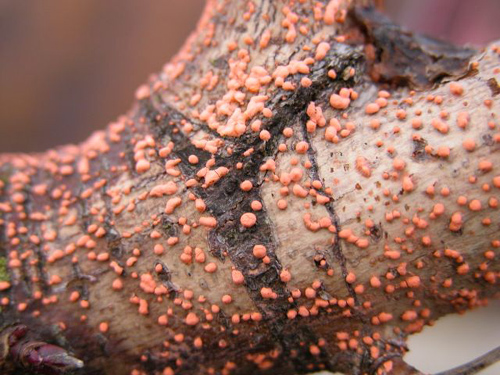
Almost all trees are susceptible to cankers, a disease of the bark or wood of a tree, caused by the Nectria fungus. It is most common in regions with a cool, humid climate. Where is occurs at relatively high elevations, it is most common on exposed slopes with shallow or infertile soils. At low elevations the disease is common in cold pockets and on poorly drained soils.

Symptoms:

  • Small, circular, brown spots
  • Brown areas with sunken, dark, centers, and raised edges
  • Raised spots which are target-like in appearance
  • Stem is swollen at level of the canker

Causes:

Nectria Canker requires bark injury such as a wound from frost cracks, sunscald, or pruning. Infection is more likely in wounds that occurred in autumn and winter than those sustained in late spring and summer, although infection can occur at any time throughout the year when temperature and moisture permit.

Treatment:

Much of the damage by Nectria Canker can be prevented by planting trees or shrubs known to be well adapted to the climate of the planting site. To aid the prevention of damage in trees and shrubs that have already been planted, minimize water stress by ensuring proper drainage and avoiding over-watering, and also avoiding untimely pruning or other wounding. Removal of trees may sometimes be the only option.

Timing of treatment:

For control on Japanese maples, three chemical applications in the later weeks of winter and early spring will also control this disease. First application is to be done in late winter. Second application a week after that and the last application two weeks after the second.

Images Provided By:

Image 1: Florida Division of Plant Industry , Florida Department of Agriculture and Consumer Services, Bugwood.org
Image 2: Joseph OBrien, USDA Forest Service, Bugwood.org
Image 3: Petr Kapitola, Central Institute for Supervising and Testing in Agriculture, Bugwood.org
Save

Save

Save

Share
2

You also might be interested in

Phenology Explained

Phenology Explained

Mar 10, 2014

Phenology explained by your certified Toronto arborists It’s not reading[...]

Info Bulletin: Diplodia Tip Blight

Info Bulletin: Diplodia Tip Blight

Jun 21, 2012

Diplodia is one of the most common and serious diseases of Austrian pines. It is caused by a fungus which becomes a destructive pathogen when its host is weakened by external factors. This disease also attacks other two and three needled pines such as mugo, Scots, and red pines.

Info Bulletin: Honey Locust Plant Bug
OLYMPUS DIGITAL CAMERA

Info Bulletin: Honey Locust Plant Bug

Mar 15, 2013

Honey Locust Plant Bug (Diaphnocoris chlorionis) Symptoms Leaf distortion Dwarfed[...]

Most Commented Posts

  • Birch leafminer treatment now available in Ontario By Ontree on February 15, 2013 4
  • Magnolia Scale Neolecanium Cornuparvum By Ontree on August 7, 2015 3
  • Pruning young trees and structural pruning By Ontree on September 8, 2014 2

Recent Comments

  • John Shribbs on Pruning young trees and structural pruning
  • Yuma on Pruning young trees and structural pruning
  • Madeline Walker on Using pesticides on trees
  • Ontree on Birch leafminer treatment now available in Ontario
  • Teressa on Birch leafminer treatment now available in Ontario

Search

Ontree

To preserve the urban forest by adding value, maintaining high standards, and developing relationships.

Contact

Ontree
22 Passmore Ave,
Scarborough, ON M1V 4T1
Phone: 416-412-2100
Email: info@ontree.ca

  • Privacy Policy
  • Site Map

Company

  • Home
  • About Us
  • Services
  • Commercial
  • News & Events
  • FAQs
  • Contact Us

FOLLOW US

Social Icons Widget

© 2026 · Ontree

Prev Next

Press Enter to search · Esc to close